

Table of Contents
- Suspension vs. No Suspension: What Actually Changes on the Road
- Ride Quality, Vibration, and Passenger Comfort
- Stability, Handling, and Bike Trailer Safety Features
- Terrain Suitability: Paved Paths vs. Uneven Terrain
- What Separates the Best Bike Trailers with Suspension
- Maintaining Bike Trailer Shocks and Long-Term Costs
- Frequently Asked Questions
Last Updated: September 18, 2026
Suspension vs. No Suspension: What Actually Changes on the Road
Do bike trailer shocks really help? Yes, for the vast majority of riders pulling children, pets, or cargo over imperfect surfaces. A suspension system absorbs road vibration before it reaches the cabin, which reduces fatigue for passengers and improves wheel contact with the ground. The trade-off is added weight and cost, so the honest answer depends on where you ride.
How a Basic Coil or Torsion Setup Works
Most trailer suspension falls into two families. A coil spring compresses over bumps and relies on a separate damper to control rebound. A torsion bar twists along its length to absorb impact and needs no separate spring housing. Both do the same job: convert a sharp jolt into a slower, smaller movement.
Why Rigid Frames Transmit Every Bump
A rigid frame has no mechanism to absorb kinetic energy, so every sidewalk crack, root, and curb sends the full force straight into the cabin and the frame itself. Over time that repeated frame stress shows up as loosened hardware and cracked welds at the axle mounts.
Ride Quality, Vibration, and Passenger Comfort
Suspension improves ride quality by reducing the amplitude and frequency of vibration reaching the passenger compartment. That much every guide says. What almost none of them explain is which vibration matters, how much of it a shock actually removes, and who inside the cabin is most sensitive to what's left.
What Vibration Actually Does to a Passenger
Road vibration reaches a trailer passenger in two forms. The first is high-frequency chatter, the constant buzz from coarse asphalt or washboard gravel. The second is low-frequency, high-amplitude impact, the thump from a root, a curb cut, or a pothole edge. These are not the same problem, and they are not solved by the same mechanism.
Why Age and Body Type Change the Answer
The keyword question, do shocks really help, has a different answer depending on who's riding.
- Infants (roughly under 12 months). A baby's neck and spine can't yet absorb sudden vertical acceleration the way an older child's can. For this group, suspension is less about comfort and more about reducing peak impact forces. A rigid trailer on a root-heaved path transmits the full jolt; a suspended trailer spreads that same energy over a longer, gentler stroke. If you're pulling an infant on anything other than smooth pavement, treat suspension as a safety-adjacent feature, not a luxury.
- Toddlers and young children. They sleep in trailers, and sleep is where suspension earns its reputation. A sleeping child can't brace against a bump, so every impact lands on a relaxed body. This is the age group where owners most often report the difference is obvious.
- Older children and cargo. A kid who's awake and holding on can absorb most bumps themselves. For pure cargo, groceries, gear, tools, suspension matters far less, because boxes don't have joints. If your trailer is mostly a cargo hauler on pavement, you can skip it.
- Senior dogs and dogs with joint issues. This is the strongest case for suspension outside of infants. A dog can't brace the way a human passenger can, and a dog with arthritis or hip dysplasia feels every sharp impact. A dog riding in a rigid trailer on gravel is being repeatedly jolted; a suspended trailer converts those jolts into a slower rise and fall.
The Honest Limits of the Benefit
Suspension is not a force field. It reduces the sharpness of impacts, not their total energy. On a genuinely rough trail, deep roots, loose rock, washboard dirt, even a well-damped trailer will move around. The realistic promise is that a passenger who would be bounced awake on a rigid trailer stays asleep on a suspended one, and a dog that would limp after a ride finishes the ride comfortably.
Stability, Handling, and Bike Trailer Safety Features
Suspension contributes to stability by keeping the wheels planted. A wheel that skips off a bump loses traction and briefly stops steering the trailer, which is when sway starts.
Rollover Risk and Center of Gravity
Rollover risk is governed mostly by center of gravity, not by shocks. Setting the axle further back and keeping the heaviest load low and centered does more for rollover resistance than any spring. Suspension helps at the margins by preventing the hop that can shift weight sideways mid-turn.
Brakes, Flags, and Visibility
The bike trailer safety features that matter most are the unglamorous ones: a working hand brake, a safety flag, and high-visibility fabric. A hand brake at the handlebar that doubles as a parking brake gives you control on descents while jogging. A safety flag keeps you visible at driver eye level.
Terrain Suitability: Paved Paths vs. Uneven Terrain
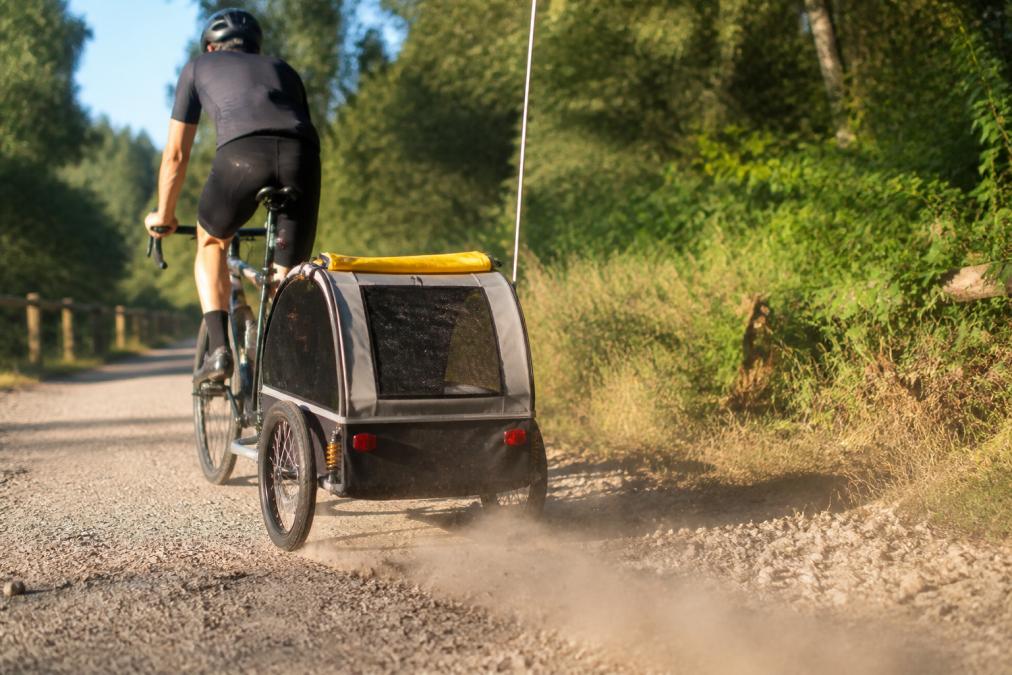
Suspension earns its keep on uneven terrain. Crushed gravel, packed dirt, tree-root sections, and cracked pavement are where the difference between a suspended and rigid trailer becomes obvious within the first mile.
Booyah Extra Large Pet Dog Stroller →
| Route Surface | Suspension Needed? | Why |
|---|---|---|
| Smooth paved greenway | Optional | Minimal impact absorption required |
| Cracked urban sidewalk | Recommended | Repeated sharp jolts add up |
| Crushed gravel trail | Strongly recommended | Constant low-amplitude vibration |
| Root-heaved dirt path | Strongly recommended | High-amplitude impacts, rollover risk |
What Separates the Best Bike Trailers with Suspension
The best bike trailers with suspension share three traits: a spring rate matched to the trailer's loaded weight, enough suspension travel to absorb real impacts, and a damping system that controls rebound rather than letting the cabin bounce.
Spring Type, Travel, and Load Capacity
Load capacity and spring rate have to work together. A stiff spring on a lightly loaded trailer rides harshly. A soft spring on a heavy load bottoms out and stops absorbing anything. Payload distribution matters too: weight placed over the axle loads the spring correctly, while weight at the rear of the cabin levers against it.
A Real-World Example: Booyah's Suspension Models
Booyah Strollers builds suspension into its all-in-one trailer, jogger, and stroller conversions rather than selling it as an add-on. The Booyah Extra Large Pet Dog Stroller Carrier and Bicycle Trailer with Suspension is rated for dogs up to 110 lbs, or two 50 lb dogs, and pairs real air-filled tires on aluminum wheels with a suspension system designed to soften the ride.

Maintaining Bike Trailer Shocks and Long-Term Costs
Maintaining bike trailer shocks is simpler than most owners expect, but it is not zero maintenance, and the long-term cost picture depends heavily on which suspension design you bought. Springs and dampers wear, and the cost of ignoring them is a trailer that rides worse than a rigid one.
Routine Care That Actually Matters
- Inspect the shock mounts every few months for play or rust. Loose mounts cause clunking and accelerate wear on everything bolted to them.
- Check tire pressure before each ride. Underinflation is the most common cause of a harsh-feeling suspended trailer, because the tire stops doing its share of the work and the shock gets overloaded.
- Clean and lubricate the pivot points where the suspension arm meets the frame. Grit in a dry pivot turns smooth travel into a grinding, sticky stroke.
- Watch for oil weeping on hydraulic dampers. A leaking damper means rebound control is gone.
- Store it dry. Moisture sitting in spring seats and pivot bores is what turns a five-year trailer into a three-year trailer.
How Each Suspension Type Fails, and What It Costs You
This is the part most guides skip, and it's the part that determines whether suspension is a one-time upgrade or an ongoing expense.
The Real Long-Term Cost Question
For a broader look at trailer setup and safety, the National Highway Traffic Safety Administration publishes guidance on bicycle safety equipment, and the Consumer Product Safety Commission maintains recall and safety information for children's products including trailers.
Frequently Asked Questions
Do bike trailers for kids need suspension?
It depends on where you ride. On smooth paved paths, a rigid trailer is fine and costs less. If your routes include cracked sidewalks, gravel, or root-heaved trails, suspension reduces the vibration and road chatter a child feels. Bike trailer shocks absorb small bumps before they reach the seat, which matters most on rides longer than 30 minutes or on surfaces that are consistently uneven.
What are the benefits of suspension on a pet bike trailer?
Senior dogs, dogs with joint issues, and larger breeds feel every bump through a rigid frame. Suspension softens that impact, which can make longer rides more comfortable for an animal that cannot shift its own weight to brace for a pothole. A trailer like the Booyah Extra Large Pet Dog Stroller and Bicycle Trailer with Suspension is rated for dogs up to 110 lbs and includes suspension to soften the ride.
Can you add suspension to a bike trailer that doesn't have it?
Aftermarket kits exist, but fitting them usually means drilling the frame, which can weaken the structure and void any warranty. Most DIY attempts also change the axle geometry, and that affects towing dynamics and stability. If suspension matters to you, buying a trailer that ships with it is the safer route than modifying a rigid one.
How does suspension affect the stability of a bike trailer?
A properly tuned shock keeps the wheels in contact with the ground instead of bouncing off it, which improves chassis stability and reduces the sideways sway you feel on rough pavement. Poorly damped suspension does the opposite: it adds rebound bounce that can unsettle the trailer at speed. Spring rate and damping have to match the load, which is why a trailer rated for 110 lbs behaves differently when it is empty.