

Table of Contents
- What Makes a Bike Trailer for Large Dogs Different
- Why Standard Trailers Fall Short for Big Breeds
- Quick Comparison: What to Look For at a Glance
- Dog Bike Trailer Weight Capacity: Matching Trailer to Dog
- Bike Trailer Suspension for Dogs: Why It Matters for Joint Health
- How to Train a Dog to Ride in a Bike Trailer
- Weight Distribution and Handling: What Big Dogs Change
- Long-Term Wear and Tear: What to Inspect
- Breed-Fitment Guide: Which Trailers Suit Which Dogs
- Frequently Asked Questions
Last Updated: September 16, 2026
What Makes a Bike Trailer for Large Dogs Different
A bike trailer for large dogs is a towed carrier built to haul 50 to 150-plus pounds, with a reinforced frame, wider wheelbase, and load-rated hitch a standard pet carrier lacks. Booyah Strollers offers all-in-one solutions that cater to dogs of all sizes, from small to extra large, ensuring comfort and safety with integrated suspension and shocks.
Why Standard Trailers Fall Short for Big Breeds
Standard trailers are engineered around a smaller payload and narrower wheelbase, so a large dog shifts weight too far back and too high. The trailer sways on turns, and the hitch arm takes stress it wasn't built for.
Three failures show up most often:
- Frame flex: Lighter tubing bows under a heavy dog, which can crack at the weld joints over time.
- Rearward weight bias: Without a low center of gravity, the load presses down on the hitch and lifts the front wheel.
- Weak safety tether points: Interior anchor points meant for a small harness can tear free in a sudden stop.
Quick Comparison: What to Look For at a Glance
Use this table to match the spec to the job before you shop.
| Spec | Why It Matters for Large Dogs | What to Look For |
|---|---|---|
| Weight capacity | Prevents frame and hitch failure | Rated payload above your dog's weight |
| Suspension | Protects joints on rough pavement | Rear suspension with adjustable shocks |
| Wheel type | Handles curbs and gravel | Quick-release wheels, all-terrain tires |
| Hitch system | Controls sway under load | Rear axle mount with a safety tether |
| Foldability | Fits your storage and car | Foldable frame with quick-attach hardware |
| Weather protection | Keeps the ride comfortable | Weather-resistant fabric, mesh ventilation |
Essential Specs Checklist
Before buying, confirm each item against the trailer's documentation:
- Rated maximum payload exceeds your dog's weight plus gear
- Rear axle mount compatible with your bike's dropout style
- Parking brake that holds on a slope
- Reflective elements and a visibility flag
- Interior floor mat that won't slide
- Roll cage or reinforced frame around the cabin
- UV-protected windows and mesh ventilation panels
- Quick-release wheels for transport and storage
If a trailer's listing can't answer these, that's your answer.
Dog Bike Trailer Weight Capacity: Matching Trailer to Dog
Dog bike trailer weight capacity is the maximum payload the frame, axle, and hitch are rated to carry, and it must exceed your dog's weight plus gear, water, or bedding. A trailer rated at exactly your dog's weight has no margin for a water bottle or blanket.
Maximum Payload and Real-World Limits
Manufacturers publish a maximum payload, but the real-world limit is lower: that number assumes even load distribution and smooth pavement. Add a pothole, curb drop, or hard turn and the effective load on the hitch spikes.
Bike Trailer Suspension for Dogs: Why It Matters for Joint Health
Bike trailer suspension for dogs matters because road vibration and curb impacts travel up through the frame into the cabin floor, and a dog on a rigid floor absorbs every jolt. Integrated suspension and shocks damp that energy before it reaches your dog.
How Trailer Suspension Actually Works
Most large-dog trailers use one of three setups:
- Rigid frame (no suspension): The cabin floor is bolted directly to the axle. Every bump transfers straight to your dog. Fine for smooth pavement, punishing on gravel.
- Coil-spring suspension: A coil spring sits between the axle and frame, with a separate shock absorber to control rebound. Most common on mid- and upper-tier large-dog trailers because coils handle variable loads better than elastomers.
- Elastomer or rubber-damped suspension: A rubber block compresses under load. Cheaper and maintenance-free, but the damping curve is fixed, tuned for one weight range and harsh once you exceed it.
The spring absorbs the bump; the shock controls how fast it returns to rest. Without a shock, a coil spring bounces the cabin like a trampoline after every curb drop, worse for a dog's joints than a firm ride.
Matching Spring Rate to Your Dog's Weight
Suspension only works if it's matched to the load. A spring rated for a 30-pound dog compresses fully under a 90-pound dog and stops absorbing anything, making the trailer effectively rigid. A spring rated for 150 pounds barely moves under a 60-pound dog, so the ride is stiff and jarring.
What to Check Before You Buy
- Confirm the suspension is rated for the trailer's full payload, not just the base model weight.
- Look for a shock absorber, not just a spring, springs without damping bounce.
- Check whether preload is adjustable, especially if your dog is near the top or bottom of the trailer's weight range.
- Ask whether replacement springs or shocks are sold separately. A trailer with proprietary, non-serviceable suspension is a disposable trailer.
Booyah Strollers equips its trailers with integrated suspension and shocks. If your dog has bad joints, that's the spec to prioritize over fabric color or storage pockets.
How to Train a Dog to Ride in a Bike Trailer
Training a dog to ride in a bike trailer takes one to three weeks of short, positive sessions, starting with the trailer parked and stationary. Rushing this step is the biggest reason dogs panic once the wheels move.
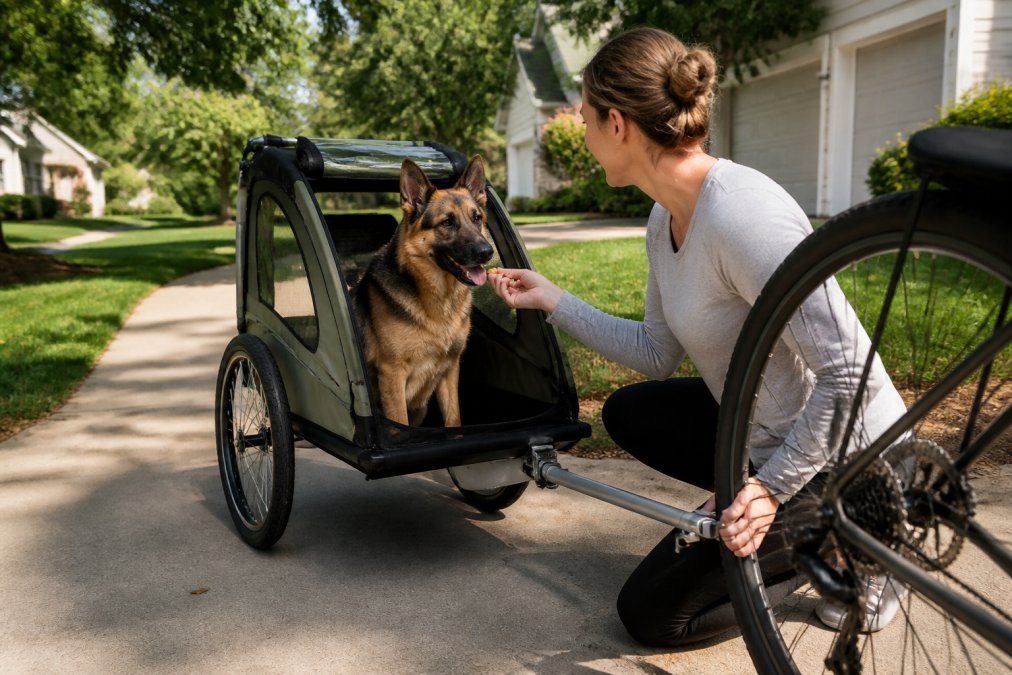
Step-by-Step Acclimation for Nervous Dogs
Follow this sequence and don't skip ahead:
- Park the trailer indoors or in the yard. Leave it open with treats and a familiar blanket inside. Let your dog investigate on their own.
- Feed meals inside the trailer. Associating the cabin with food builds positive emotion fast.
- Close the door briefly. Start with seconds, then build to a minute while you stand nearby.
- Attach the harness and safety tether. Let your dog feel the restraint while stationary.
- Push the trailer a few feet. No bike yet. Just movement and your calm voice.
- Hitch to the bike and walk it. Your dog rides while you walk alongside.
- Ride short distances. Five minutes, then ten, then longer as your dog settles.
For a nervous dog, add a worn t-shirt with your scent to the cabin. It calms most anxious riders.
Train on an empty stomach. A slightly hungry dog is far more motivated by treats inside the trailer than one that just ate. Use high-value rewards reserved only for trailer sessions.
Weight Distribution and Handling: What Big Dogs Change
A large dog changes how your bike handles because the load sits behind and below your rear wheel, shifting your center of gravity and altering steering feel, the variable most owners never think about until the first wobbly turn.
Three handling effects to expect:
- Slower steering: The added rear weight makes the front wheel feel light. Turn earlier and wider.
- Longer stopping distance: You're braking more mass. Start braking sooner.
- Sway on descents: A high or rear-biased load amplifies sway. Keep the heaviest part of the load low and centered over the axle.
Long-Term Wear and Tear: What to Inspect
Long-term wear on a large-dog trailer concentrates in four places, and inspecting them monthly prevents mid-ride failures. Big dogs accelerate wear because every component carries more load.
Inspect these on a schedule:
- Hitch arm and coupler: Look for elongation, cracks, or play at the pivot.
- Wheel bearings: Spin each wheel. Grinding or wobble means replacement.
- Frame welds: Check the joints around the axle mounts and cabin corners.
- Fabric and mesh: Look for seam separation and UV degradation, especially on windows and ventilation panels.
Breed-Fitment Guide: Which Trailers Suit Which Dogs
Breed fitment comes down to standing height, body length, and weight, not breed reputation. A tall, narrow dog needs cabin height; a long, low dog needs floor length. Here's the method and the numbers to use.
Measure These Three Numbers First
Before you look at any trailer listing, measure your dog:
- Standing shoulder height, floor to the top of the shoulder blades, while your dog stands square. This sets the minimum interior cabin height.
- Nose-to-tail length, from the tip of the nose to the base of the tail, while standing. This sets the minimum interior floor length.
- Weight, weigh at the vet, not from memory. A "70-pound" German Shepherd is often 80.
Fitment Table by Size Class
Use this as a starting filter, then confirm against the trailer's published interior dimensions.
| Size Class | Typical Breeds | Standing Height | Body Length | Weight | Minimum Cabin Target |
|---|---|---|---|---|---|
| Large | Labrador, Golden Retriever, Boxer | 22-25 in | 32-36 in | 60-80 lbs | 28 in H x 38 in L |
| Extra Large | German Shepherd, Rottweiler, Bernese | 24-27 in | 36-40 in | 75-100 lbs | 30 in H x 42 in L |
| Giant | Great Dane, Mastiff, Saint Bernard | 28-32 in | 40-48 in | 110-160 lbs | 34 in H x 50 in L |
Breed-Specific Notes
- German Shepherds, Labs, Goldens (60-90 lbs): Need a wide cabin and a payload rating with headroom. Look for reinforced floors and a low center of gravity. These breeds fit most large-dog trailers, but confirm cabin width, a broad-chested Lab can be wider than the door opening on a narrow trailer.
- Great Danes, Mastiffs (120+ lbs): Need the highest payload tier, a durable chassis, and generous ground clearance. Confirm the cabin height lets your dog stand without crouching. A Dane that can't stand will lie down and slide on turns, a stability problem, not just comfort.
- Senior or mobility-impaired dogs: Prioritize suspension and an interior floor mat for traction. A dog that can't brace needs a smooth, stable ride. Avoid trailers with a high step-in height; a senior dog may need a ramp.
- Two dogs or a dog plus a child: Confirm the combined weight against the maximum payload. Most trailers aren't rated for both at once, and the ones that are will say so explicitly. Two 60-pound dogs in a trailer rated for 100 pounds is over the limit.
The Fitment Check Nobody Does
Before you buy, cut a piece of cardboard to the trailer's published interior floor dimensions and lay it on the ground. Walk your dog onto it. If any part hangs off the cardboard, the trailer is too small; if your dog can't stand without its head touching an imaginary ceiling at the cabin height, it's too short.
Bring a tape measure to the store or measure the trailer at home within the return window. Published dimensions are sometimes exterior, not interior. The difference can be 2 to 4 inches, enough to turn a good fit into a cramped one.
Frequently Asked Questions
What is the best bike trailer for big dogs?
The best bike trailer for large dogs has a weight capacity at least 20% above your dog's weight, a low center of gravity, and a wide wheelbase. Look for a quick-release wheel system, a safety tether, and a parking brake. Booyah Strollers offers all-in-one bike trailers with integrated suspension that fit dogs from small to extra large. Always check the maximum payload before buying.
Is there a dog bike trailer that can hold a dog up to 100 lbs?
Yes, some trailers are rated for 100 lbs or more, but you need to check the maximum payload carefully. A trailer rated for 100 lbs may only carry 80 lbs of dog once you account for the trailer's own weight and any cargo. Look for a durable chassis, a wide wheelbase, and a low center of gravity to keep the ride stable. Booyah Strollers designs trailers to accommodate extra-large dogs.
How do I train a dog to ride in a bike trailer?
Start by leaving the trailer open in your home with treats inside. Let your dog explore it at their own pace. Once they're comfortable, close the door for a few seconds, then gradually increase the time. Next, attach the trailer to your bike and walk it around the yard before riding. Use a safety tether and keep the first rides short and slow. Reward calm behavior.
What features should I look for in a large dog bike trailer?
Prioritize weight capacity, suspension, and safety. A suspension system absorbs bumps and protects your dog's joints. Look for a safety tether, reflective elements, and a parking brake. Quick-release wheels make storage easier. A weather-resistant fabric with mesh ventilation keeps your dog comfortable. Also check that the trailer fits your bike's rear axle mount without needing extra adapters.