

Table of Contents
- What Makes a Good Cargo Trailer Alternative
- Best Bike Cargo Trailers: Key Specs to Compare
- Bike Trailer Weight Capacity: How Much Can You Actually Carry
- Flatbed vs. Enclosed Bike Trailer: Which Design Fits Your Needs
- Burley Travoy Alternatives Worth Considering
- Hitch Compatibility and Setup: What You Need to Know
- Real-World Use Cases and Load Scenarios
- Conclusion: Finding Your Cargo Trailer
- Frequently Asked Questions
Last Updated: October 9, 2026
What Makes a Good Cargo Trailer Alternative
When you're shopping for a cargo trailer alternative, you're really asking: what can handle my load, fit my bike, and work in my daily routine?
A good cargo trailer alternative needs three things: enough load capacity for what you're carrying, secure attachment to your bike without a toolbox of adapters, and the ability to fold or compact when not in use, because a trailer that won't fit in your apartment or garage becomes a garage sale candidate fast.
The mistake most people make is comparing trailers on a single factor. Capacity without stability is dangerous. A trailer that folds but weighs 50 pounds defeats the purpose of portability. And a cheap option that doesn't fit your bike hitch is money down the drain.
What separates a trailer you'll actually use from one that sits unused is how well it matches your situation. A touring cyclist needs different features than an urban commuter, and hauling a dog differs from moving camping gear.
Best Bike Cargo Trailers: Key Specs to Compare
The specifications that matter most directly affect how the trailer performs in your life. Load capacity tells you the maximum weight the frame and wheels can handle. Trailer weight matters because you're the one moving it. Wheel size affects stability and how smoothly it rolls over obstacles.
When comparing bike cargo trailers, focus on these core specifications:
- Load capacity: The maximum weight the trailer can safely carry. Weight distribution and center of gravity affect handling more than raw capacity alone.
- Trailer weight: How much the empty trailer itself weighs. Lighter trailers are easier to maneuver and store, but they sometimes sacrifice durability.
- Wheel size: Larger wheels (20 inches versus 16 inches) roll more smoothly over rough surfaces and curbs. Smaller wheels are more compact but can feel twitchy at speed.
- Frame material: Aluminum resists rust and keeps weight down. Steel is heavier but often more durable for rough use.
- Hitch type: The connection point to your bike. Universal hitches work on most bikes, but some require adapters. Quick-release mechanisms are faster than clamp-style connections.
- Folding mechanism: Some trailers fold flat, others collapse partially. Ease of folding and the final storage footprint vary widely.
The Booyah Strollers Cargo Beach Cart Stroller & Bike Trailer combines practical specs with real-world usability: 20-inch wheels (larger than most competitors), a 110-pound weight capacity, and quick-release wheels that take seconds to remove. The included bike arm and hitch fold out from underneath the cart, so you're not fumbling with separate pieces.

Bike Trailer Weight Capacity: How Much Can You Actually Carry
Weight capacity is a number, but understanding what it means in practice changes how you use the trailer. A 110-pound capacity sounds substantial until you realize that's the absolute maximum, the point where you're risking frame damage and poor handling.
In reality, you should load most cargo trailers to 70-80 percent of rated capacity for stable handling. That means a 110-pound trailer carries around 75-90 pounds comfortably. Beyond that, the trailer becomes harder to steer, less responsive to balance shifts, and more likely to sway when you brake or turn.
What you're carrying matters more than the weight itself. A 70-pound dog sitting low feels more stable than 70 pounds of groceries stacked high. A single heavy item like a cooler handles differently than the same weight spread across smaller items. Bulky but light loads take up space but don't stress the frame.
The real question isn't "Can I technically fit this weight?" but "Will this trailer handle what I'm carrying safely and predictably?" A low center of gravity keeps the trailer stable under load, suspension absorbs bumps instead of transferring them to your bike, and a wide wheelbase provides better balance than a narrow one.
For most users, a cargo trailer with a 110-pound capacity covers typical use cases: a week's groceries, sports equipment, a medium-sized dog, or weekend camping gear. If you regularly move heavier loads, you're looking at a different category of equipment entirely.
Flatbed vs. Enclosed Bike Trailer: Which Design Fits Your Needs
The choice between a flatbed and enclosed cargo trailer comes down to what you're moving and where. Each design has genuine trade-offs.
A flatbed cargo trailer (also called an open cargo area design) offers maximum flexibility. You can load long items like fishing poles, surfboards, or tent poles that would never fit in an enclosed box, see everything at a glance, and grab items without opening a door or lid. Flatbed designs are typically lighter because they skip walls and cover. The trade-off: everything you carry is exposed to weather, dust, and theft risk.
An enclosed cargo trailer protects your load from rain, sun, and road spray, keeps groceries dry, and shields your dog from wind and weather. It's more secure, thieves can't see inside, and lighter items won't blow away on the highway.
The Booyah Strollers Cargo Beach Cart Stroller & Bike Trailer uses a hybrid approach: essentially a flatbed with optional coverage. The included cargo cover protects from sun and rain when needed, but removes for maximum flexibility. The open "alleyway" design lets longer items pass straight through without hitting the sides, useful for surfboards, fishing poles, baseball bats, or camping equipment.
Most urban commuters doing grocery runs benefit from an enclosed design for weather protection, while recreational users moving sports gear or camping equipment often prefer flatbed flexibility. If you're doing both, a convertible design gives you options.
Burley Travoy Alternatives Worth Considering
The Burley Travoy is a popular reference point because it's well-designed and widely available, but it's not always the best option. Understanding what the Travoy does well and where it has limitations helps you evaluate cargo trailer alternatives.
Cargo trailer alternatives to the Travoy fall into a few categories. For more capacity and a heavier trailer, the Booyah Strollers Cargo Beach Cart Stroller & Bike Trailer offers 110-pound capacity, 20-inch wheels, and quick-release wheels for faster setup and storage. For maximum compactness, ultra-light trailers under 15 pounds sacrifice capacity and durability.
The real question isn't "Is the Travoy good?" It is.
Cargo Beach Cart Stroller & Bike Trailer with Cover– 3-in-1 Cargo Wagon →
Hitch Compatibility and Setup: What You Need to Know
The hitch is where theory meets reality. A trailer with perfect specs becomes useless if it doesn't attach to your bike without adapters, modifications, or frustration. Understanding hitch compatibility before you buy saves money and headaches.
Most bikes use one of a few standard hitch types. The most common is a seatpost-mounted hitch, where the trailer connects to the tube that holds your seat. Some bikes have dropout-mounted hitches at the rear axle, cargo and mountain bikes use frame-mounted connections, and electric bikes sometimes have different hitch points because of motor placement.
A universal hitch works with multiple attachment points, but "universal" doesn't mean every bike. Some older bikes or unusual geometries require specific adapters. Before buying, measure your seatpost diameter and check where your frame allows hitch attachment.
The Booyah Strollers Cargo Beach Cart Stroller & Bike Trailer includes a standard bike arm and hitch plus an e-bike hitch option. The hitch uses a quick-release mechanism, push a button to attach or remove the trailer, not twist clamps repeatedly. This matters if you attach and detach multiple times per week.
Setup also means understanding how the trailer affects handling. A loaded trailer shifts your center of gravity backward, making your front wheel lighter and twitchy in tight turns, and your braking power must account for the trailer's weight. Some trailers have their own braking system or drag brakes to prevent jackknifing on steep descents. Understanding these dynamics before your first loaded ride prevents surprises.
Hitch Type |
Best For |
Setup Complexity |
Compatibility |
|---|---|---|---|
Seatpost-mounted |
Most standard bikes |
Low (simple clamp) |
Universal with adapters |
Dropout-mounted |
Mountain bikes, cargo bikes |
Medium (frame-specific) |
Limited, bike-specific |
Quick-release |
Frequent attach/detach |
Low (push-button) |
Works with compatible bikes |
E-bike specific |
Electric bikes |
Medium (motor clearance) |
E-bikes only |
Real-World Use Cases and Load Scenarios
The difference between a good cargo trailer and the right cargo trailer emerges when you load it with actual stuff in actual conditions, navigating a crowded bike path with groceries or moving a 60-pound dog across rough pavement.
Urban grocery runs: You're carrying 30-50 pounds of groceries three blocks home. You need quick attachment, weather protection, and easy access.
Dog transport: You have a 50-70 pound dog with joint issues who needs smooth rides. Weight distribution matters more than raw capacity.
Sports and recreation: You're moving camping gear, fishing equipment, or sports gear to a trailhead. You need flexibility for long items (tent poles, fishing rods, surfboards) and durability for awkwardly shaped loads.
Commuting with cargo: You're biking to work with a laptop, lunch, and extra clothes. You need something compact that doesn't make your bike unwieldy in traffic, folds down for office storage, and attaches quickly. A lightweight, quick-release trailer with moderate capacity (50-75 pounds) works here, you're not moving heavy loads, so you prioritize speed and compactness.
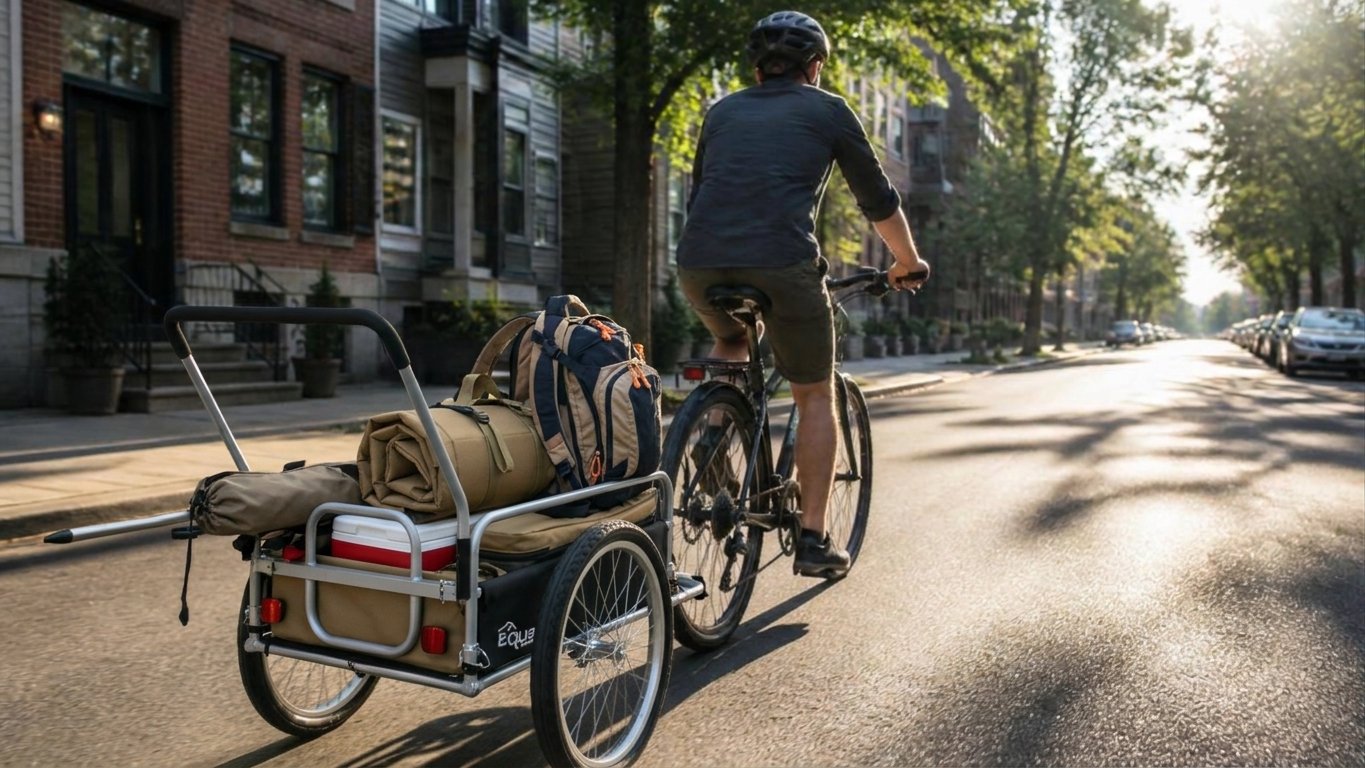
The common thread: the best trailer matches your actual load and routine. A 110-pound capacity matters only if you're loading 110 pounds. Quick-release attachment matters only if you attach and detach frequently. Suspension matters only if your loads are fragile or your dog's joints are sensitive.
Conclusion: Finding Your Cargo Trailer
Choosing a cargo trailer alternative comes down to matching three things: your actual load, your bike's compatibility, and your daily workflow. Specs matter only in context.
Be honest about what you're moving and how often. Most people overestimate their capacity needs and underestimate ease of use. A trailer you'll actually use beats a theoretically perfect one that stays in the garage because it's annoying to set up.
Check compatibility before you buy: measure your seatpost, verify your hitch attachment points, and confirm the quick-release or clamp system works with your bike geometry. A few minutes of research saves frustration later.
If you're looking for a cargo trailer that handles diverse loads, attaches quickly, and doesn't require a second mortgage, the Booyah Strollers Cargo Beach Cart Stroller & Bike Trailer delivers on all three fronts. The 110-pound capacity, 20-inch wheels, quick-release system, and included e-bike hitch cover most real-world scenarios. The alleyway design solves the "won't fit" problem that stops you cold with other trailers. And at $230 with free shipping and free returns, you're not gambling on an expensive experiment.
The right cargo trailer becomes invisible, you stop thinking about whether it'll work and start thinking about where you're going next.
Frequently Asked Questions
How much weight can a bike cargo trailer carry?
Most cargo trailers range from 75 to 110 pounds capacity. The Cargo Beach Cart Stroller and Bike Trailer, for example, handles up to 110 pounds. Always check the manufacturer's weight limit—exceeding it compromises stability and can damage the frame. Your total load includes the trailer itself, so subtract its weight from the capacity to find usable cargo space. Heavier loads affect handling and braking performance.
Is a flatbed or enclosed bike cargo trailer better?
Flatbed trailers offer versatility for odd-shaped items like surfboards, fishing poles, and sports equipment. Enclosed designs protect contents from weather and work well for regular commuting with sensitive cargo. Flatbed models are typically lighter and more affordable, while enclosed options provide security and weatherproofing. Your choice depends on what you carry most often and whether protection matters for your use case.
What should I compare when choosing a cargo bike trailer?
Prioritize weight capacity, hitch compatibility with your bike, wheel size, and folding/storage convenience. Check if the trailer fits through doorways and elevators if you live in a compact space. Consider suspension quality for smooth rides, especially with fragile cargo. Compare total cost including any adapters needed, and verify return policies in case the trailer doesn't fit your bike or needs.
Are Burley Travoy alternatives actually cheaper?
The Cargo Beach Cart Stroller and Bike Trailer starts at $230 and includes suspension, 20-inch wheels, and a bike hitch. Compare total value—not just price—by factoring in weight capacity, included accessories, warranty, and return policies. Guaranteed lowest price guarantees can save money if you find better pricing elsewhere.
Finding the right cargo trailer means choosing equipment that actually fits how you bike and what you carry. Booyah Strollers offers a cargo trailer alternative that combines practical capacity, quick setup, and real-world durability. Get started with the Cargo Beach Cart Stroller & Bike Trailer and move what matters without compromise.