

Table of Contents
- What Makes a Bike Trailer Good for Jogging
- Quick Comparison: 3-in-1 Trailers for Jogging
- Booyah 3-in-1 Double Trailer: Best Overall for Jogging
- Booyah Black Child II: Best Budget Jogging Trailer
- Bike Trailer Stroller Conversion Kit: What's Included and How It Works
- Safety Standards for Child Bike Trailers: What to Check Before You Buy
- Jogging Stroller vs Bike Trailer: Which One Do You Need?
- Maintenance and Storage: Making Your Trailer Last
- Frequently Asked Questions
Last Updated: September 27, 2026
What Makes a Bike Trailer Good for Jogging
A bike trailer for jogging needs two things a standard trailer lacks: a front wheel that locks straight and a brake you can reach while running. A swiveling front wheel is fine for walking errands but dangerous at running pace.
Locking Front Wheel and Handlebar Brake
The front wheel must lock into a fixed forward position so the trailer tracks straight instead of pivoting with every stride. A 12-inch front wheel is the common size: it swivels for stroller mode, then locks for running. The handlebar brake slows your pace on descents and doubles as a parking brake.
Suspension and Weight Capacity
Suspension softens the ride for a seated child, absorbing the small bumps on gravel, cracked pavement, and packed trail that otherwise travel straight into the seat.
Quick Comparison: 3-in-1 Trailers for Jogging
Model |
Price |
Weight Capacity |
Front Wheel |
Brake |
|---|---|---|---|---|
Booyah 3-in-1 Double (Red) |
$305.00 |
88 lbs |
12-inch swivel, locks |
Handlebar brake |
Booyah 3-in-1 Double (Orange) |
$295.00 |
88 lbs |
12-inch swivel, locks |
Handlebar parking brake |
Booyah 3-in-1 Double (Green) |
$285.00 |
88 lbs |
12-inch swivel, locks |
Handlebar parking brake |
Booyah Child II (Black) |
$220.00 |
88 lbs |
12-inch swivel, locks |
Handbrake, parking brake |
Every model converts between stroller, jogger, and bike trailer; the differences come down to color and price.

Booyah 3-in-1 Double Trailer: Best Overall for Jogging
The Booyah 3-in-1 Double Trailer ships with every part you need for all three modes, including a handlebar brake for parking and pace control.
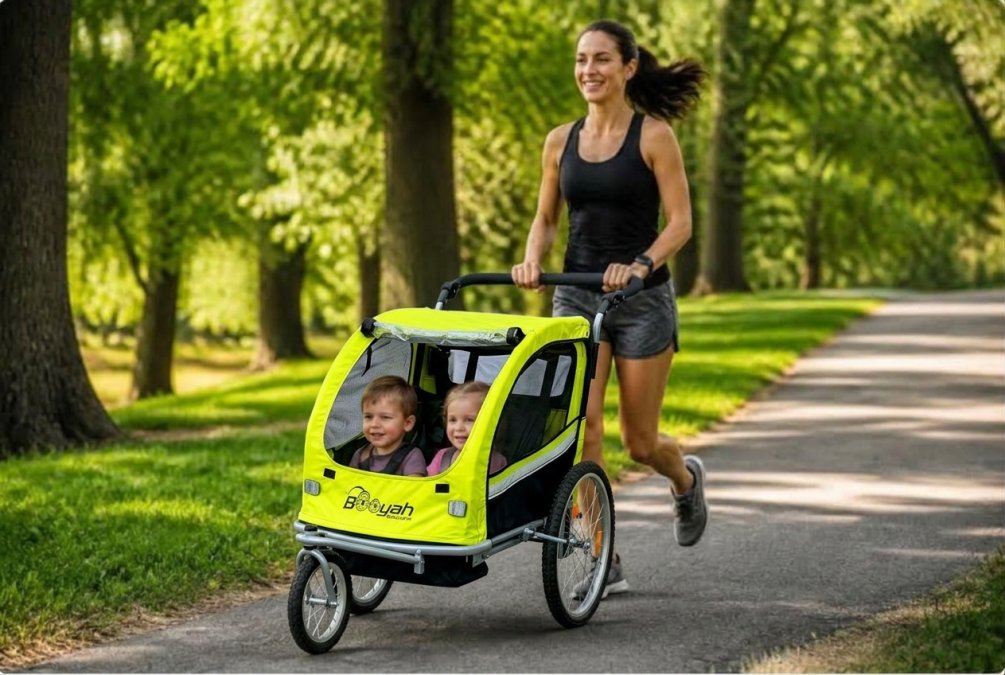
Booyah Black Child II: Best Budget Jogging Trailer
The Booyah Child II in black is the lowest-priced way into jogging with a trailer at $220.00, keeping the parts that matter: suspension, a locking 12-inch front wheel, and a handbrake that doubles as a parking brake.
Bike Trailer Stroller Conversion Kit: What's Included and How It Works
A bike trailer stroller conversion kit turns a tow-behind trailer into a pushable stroller or jogger. On Booyah models it includes the 12-inch front wheel, adjustable handlebar, and bike arm and hitch, everything ships in the box.
The Four-Part Conversion Sequence
Conversion takes a few minutes once you have done it once:
- Remove the bike arm and hitch from the frame. Set the hitch pin and safety strap aside, you will need both when you switch back.
- Attach the front wheel assembly to the front mount. Seat the axle fully in the bracket before tightening; a partially seated axle is the most common cause of a wobbly front end.
- Install the handlebar and check the brake cable. Squeeze the lever and confirm the pads engage before the lever reaches the grip.
- Store the front wheel on the rear prongs when you switch back to trailer mode.
Axle Compatibility: The Step Most Buyers Get Wrong
Before buying any conversion kit, confirm how your bike's rear wheel attaches. Two common systems exist, and they are not interchangeable without the right adapter.
- Quick-release (QR) axles. A lever-actuated skewer holds the wheel. This is the most common setup on older and mid-range bikes, and most trailer hitches are designed around it. The hitch replaces your existing skewer with a longer one that has a mounting point for the trailer arm.
- Thru-axles. A bolt threads through the frame and hub rather than clamping on the outside. Thru-axles are standard on most modern road, gravel, and mountain bikes. A standard QR hitch will not fit. You need a thru-axle adapter matched to your axle's thread pitch and length, typically printed on the axle itself (for example, M12 x 1.5 x 142 mm).
Hitch Mounting: Axle vs. Seat Post
Seat-post hitches are easier to install but less stable under load: they can rotate during hard braking and shift the trailer's tracking. Axle-mounted hitches, the type Booyah uses, bolt to a fixed point and keep the trailer arm at a consistent angle, which matters more at jogging pace.
What to Check After Every Conversion
- The hitch pin is fully seated and the safety strap is looped through the frame, not just clipped to itself.
- The front wheel spins freely and the quick-release lever is tight enough that you cannot rock the wheel by hand.
- The brake lever engages the wheel before it bottoms out against the grip.
- The handlebar height is locked. A handlebar that slips mid-run is a fall risk.
Safety Standards for Child Bike Trailers: What to Check Before You Buy
Safety standards for child bike trailers in the United States fall under ASTM International, which publishes voluntary consensus standards for trailer construction, restraints, and testing. The ASTM Committee F08 on Sports Equipment and Facilities maintains the standards covering bicycle trailers and child carriers. "Voluntary" is the key word: the standards are not federal law, so a manufacturer can sell a trailer that has not been tested to them.
What the Standards Actually Test
ASTM's trailer standards cover testing that maps directly to the failure modes parents worry about:
Booyah 3 in 1 Double Baby Bike Bicycle →
- Structural integrity. The frame and hitch are loaded and cycled to simulate towing forces. A trailer that passes will not fold or detach under normal towing loads.
- Restraint performance. The harness is pull-tested to confirm it holds a child in a tip-over or sudden stop. Five-point harnesses with a crotch strap are the baseline; a lap belt alone is not sufficient.
- Tip-over stability. The trailer is tested for lateral stability so it does not roll when a child leans or when you take a corner at speed.
- Sharp edges and pinch points. Fabrication is inspected for edges that could cut a child and hinges that could pinch fingers.
- Flammability. Fabric and foam are tested for burn rate, the same category of testing used for children's sleepwear and car seats.
The Pre-Purchase Checklist
Before buying, confirm these items:
- A five-point restraint harness for each seating position, with a crotch strap and adjustable shoulder height.
- A roll cage or rigid frame that holds shape in a tip-over. Push down on the frame, it should not flex more than a fraction of an inch.
- A parking brake that engages independently of your hands, keeping the trailer from rolling when you stop on a slope.
- Reflectors or reflective material on the frame and fabric. Most states require reflectors on trailers towed on public roads; check your state's vehicle code.
- A tether or wrist strap if you plan to jog, your last line of control if you fall.
- A hitch that attaches at the rear axle rather than the seat post. Axle-mounted hitches keep the trailer tracking straight under load.
Checking for Recalls
The U.S. Consumer Product Safety Commission publishes recall notices and safety guidance for juvenile products, including trailers and strollers. Checking for open recalls takes two minutes and is worth doing before any used purchase. Search by brand and model number, not just by the name on the box, recalls are often specific to a production run.
For a used trailer, also check:
- The manufacture date on the frame label. Fabric and plastic parts degrade with age, and a trailer more than about eight to ten years old may have UV-brittled straps even if it looks fine.
- The hitch hardware. Missing pins, bent arms, or a stretched safety strap are reasons to walk away.
- The harness webbing. Fraying at the buckle or a faded, stiff strap means the webbing has lost strength.
State Law and Towing Rules
Trailer towing rules vary by state. Common requirements include a rear reflector or light, a safety flag at a certain height, and a maximum trailer width. Some states require a hitch safety strap in addition to the primary connection. The National Highway Traffic Safety Administration publishes general bicycle safety guidance, but for towing specifics, check your state's department of motor vehicles or vehicle code directly.
Jogging Stroller vs Bike Trailer: Which One Do You Need?
A jogging stroller is built for running only. A bike trailer is built for towing behind a bike, and a convertible model adds jogging and walking modes. If you own a bike and want one piece of equipment for both activities, a 3-in-1 trailer is the more economical choice.
A dedicated jogging stroller cannot attach to your bike.
Factor |
Jogging Stroller |
Convertible Trailer |
|---|---|---|
Bike towing |
No |
Yes |
Jogging |
Yes |
Yes, wheel locked |
Storage folded |
Smaller |
Larger |
Best for |
Runners only |
Runners who also ride |
Maintenance and Storage: Making Your Trailer Last
Durability comes down to four habits; most trailer problems trace back to skipping one.
Frequently Asked Questions
Which bike trailer can be converted into a jogging stroller?
Any 3-in-1 trailer with a swivel front wheel that locks and a handlebar brake works as a jogging stroller. The Booyah 3-in-1 Double Trailer includes a 12-inch front wheel that swivels for walking and locks for jogging, plus an adjustable handlebar with a built-in brake for slowing down. You remove the bike arm, attach the front wheel, and you're ready to run.
Is it safe to jog with a bike trailer?
Yes, if the trailer is designed for jogging and you follow a few rules. Use a trailer with a locking front wheel, a five-point safety harness, and a hand brake. Check that the trailer meets ASTM safety standards for child bike trailers. Start on smooth, flat surfaces, avoid steep hills, and never exceed the weight capacity. The Booyah trailers support up to 88 lbs combined.
What is the difference between a jogging stroller and a bike trailer?
A jogging stroller is built for running with a fixed or lockable front wheel and a hand brake, but it cannot attach to a bike. A bike trailer connects to your bicycle with a hitch and arm, and some models convert into a jogging stroller by swapping the front wheel and handlebar. The Booyah 3-in-1 does both, so you get one product for running, walking, and cycling.
What features should I look for in a jogging bike trailer?
Look for a locking swivel front wheel, a handlebar brake for slowing down, suspension to absorb bumps, a five-point child safety harness, and a canopy with UV protection. Check the weight capacity and minimum child age. The Booyah 3-in-1 has all of these: 12-inch locking front wheel, handlebar brake, suspension, 90% UV-blocking canopy, and an 88 lb capacity for two children.
Can you run with a bike trailer that is still attached to a bike?
No. You must remove the bike arm and hitch before using the trailer as a jogging stroller. Running with the bike attached is dangerous because the arm can catch on obstacles and the trailer will not track properly. The Booyah 3-in-1 conversion takes a few minutes: detach the arm, attach the front wheel, and adjust the handlebar.